October 6th, 2026.
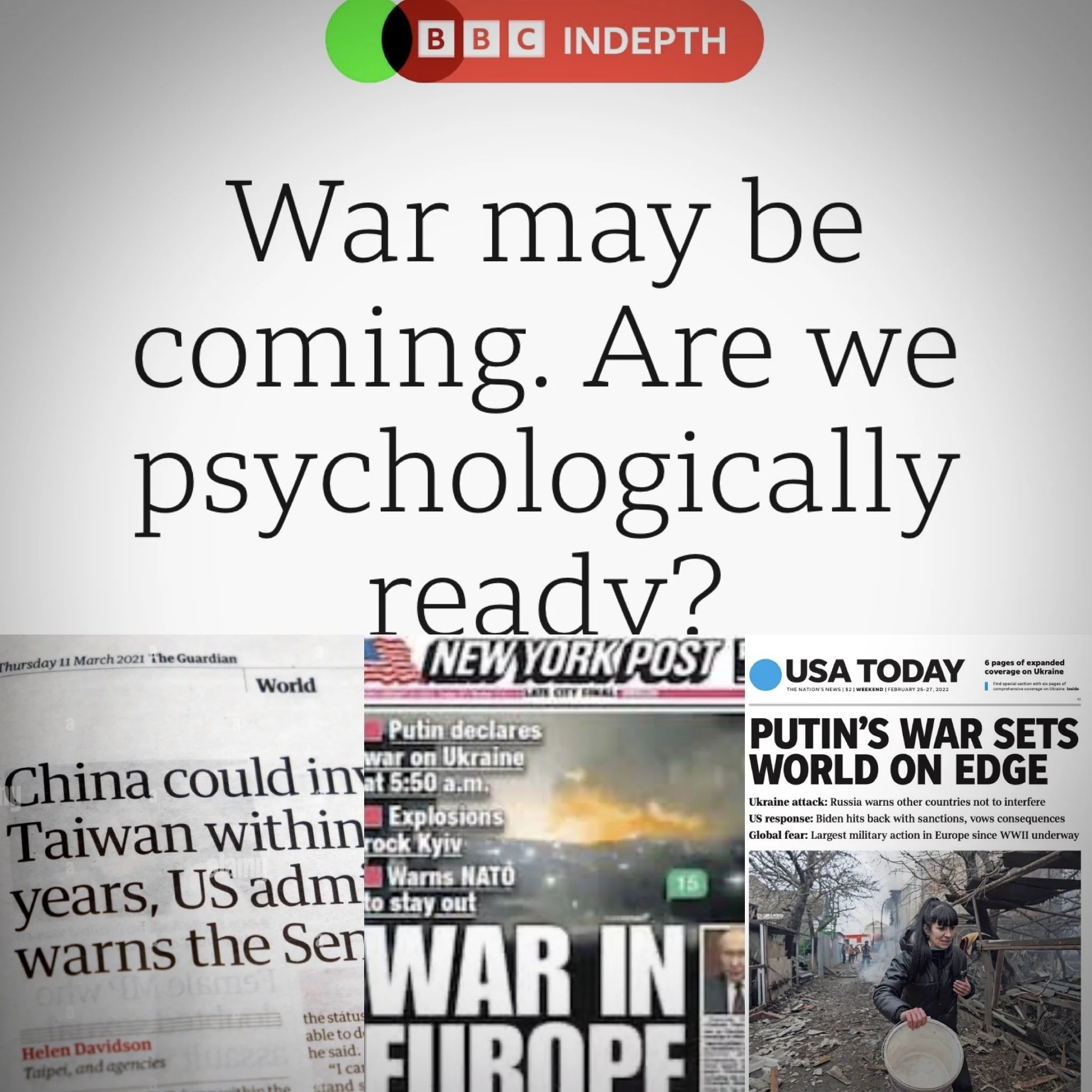
A seminar I delivered a couple of months ago at the British Wildfires Festival entitled ‘Prepare for War’ has elicited a great deal of coverage, much of which has failed to accurately reflect the content or tone of my original message. In the last few weeks, I have received (and declined) requests for interviews, articles, discussions and even ‘to rush off a quick book’ relating to this theme. The talk itself has, I’m told, been downloaded many thousands of times, shared extensively online, and discussed broadly in a range of different contexts. This is obviously a very serious topic indeed – not one I have broached lightly - and I wish, therefore, to clarify a few misunderstandings.
I want to make clear that - contrary to the tenor of some of the subsequent coverage - I am not the one prophesying war. Quite the reverse: I am calling Christians to pray urgently against war, for peace. However, it is a sober reality that a number of world leaders (who obviously know far more about these things than me) are predicting a global escalation in war, and I think we would be very foolish indeed to ignore them.
Escalation
There are currently 130 armed conflicts (‘minor wars’) in the world, and eight major ones (classified as such if they are costing more than 10,000 lives a year). This is double what it was fifteen years ago. Against this backdrop, many eminent leaders on both the left and the right are predicting a significant further escalation of international conflict, beginning with cyber-attacks. For example, the Polish Prime Minister, Donald Tusk, described Europe as being in a "pre-war era", and the British Prime Minister, warned last year that the UK must transition to "war-fighting readiness" following intelligence suggesting a Russian attack on NATO by 2030. Meanwhile, the NATO Secretary General, Mark Rutte, and American Admiral Philip Davidson, have both warned about the possibility of China invading Taiwan next year. On September 18th the BBC ran a headline ‘War May Be Coming’ revealing that work has begun on the British government’s so-called ‘war book’. And in the last few days, the President of the International Red Cross has warned the New York Times that world leaders are pushing humanity ‘toward an unrecognised new world war.’
The list of gloomy predictions goes on and on.
A call to Prayer
As a pastor I have no desire whatsoever to sow panic and fear. And as a prayer leader, I believe it’s my role, in response to such grave warnings, to do what I can to mobilise the church to intercede urgently for peace, to pray as we have been urged to do, for ‘all those in authority over us, that we may live peaceful and quiet lives’ (1 Timothy 2:2), and to make practical preparations too. That’s why, earlier this year, 24-7 Prayer hosted a Global Day of Prayer for Peace, in which 3,500 people interceded over 24 hours in 12 different languages culminating with an hour in which believers from Ukraine and Russia, America and Iran prayed together as one. There is much more to do. This was just a start.
It is not my intention to credentialise any one political perspective, but with so many dire warnings of an immanent escalation in global conflict, this cannot be a time for business as usual. Please God, let these predictions be wrong. But if they’re not, God help us if we don’t pray passionately and prepare practically while we still have time to do so. As one senior military official told me:
"We are probably already at war. However, I don't worry too much about the future because ultimately, I trust in Jesus. I must do what he has called me to do, and each of his followers must do the same. We must ultimately be shaped not by the agendas of the strong men of our day, but by the Prince of Peace himself."
Amen.
—-//
adendum (October 14th 2026)
Please note that my seminar at Wildfires was the second in a two-part series. Part one was entitled ‘War, Fear, And The Future’ . It addressed the theology of war as well as the pastoral implications of living at such a time and was delivered by Dr Jason Swan Clark, who is a professor at George Fox University in Portland, OR and Director of the London Centre for Spiritual Direction.
I would ask anyone wishing to cite my seminar to please ensure that they -
1. make it clear that the majority of my message was a call to pray for peace and to prepare pastorally.
2. don’t associate me or my message with people and positions that I have never and would never espouse.
3. acknowledge the cultural context. This was not a global press statement but rather a seminar in a tent in the UK delivered in a tone which was gentle, an environment which was interactive, and it was warmly received.
4. don’t take my words out of context (as a number of others appear to have done in order to build their own argument whilst ignoring other things I said which clearly countered their narrative).
5. encourage people to check out the source material for themselves, listening to the actual seminar rather than the subsequent commentary which has often been sensationalised or has taken me out of context.
